
Doberman Intelligence System
See the market as a system.
DIS organizes cross-market evidence across liquidity, crypto positioning, energy systems and AI infrastructure into a traceable view of current market conditions.
Live system / Current state
Intelligence in operation.
DIS organizes current market evidence into system state, module state and historical context.
Global regimeNEUTRALObserved 07 Oct 2026, 00:16 UTC
- Confidence
- 45%
- Data health
- LIVE
- Updated
- 07 Oct 2026, 21:14 UTC
Historical intelligence
AI Infrastructure / GPU Supply
Real observed history from the live DIS system. Values are presented as recorded; no smoothing or analytical logic is reproduced here.
AI Infrastructure / GPU Supply2.0707 Oct 2026 · 281 observations
Public architecture
From evidence to interpretation.
This is the conceptual path. Exact sources, transformations, thresholds and weights remain private.
- 01Time hierarchy
Observe
Separate fast positioning, daily flows and structural pressure so every input is read at the horizon where it is meaningful.
- 02Evidence layer
Normalize
Retain provenance, timestamp and freshness while converting heterogeneous observations into comparable analytical inputs.
- 03Analytical layer
Derive
Measure changes, relative pressure and cross-market relationships rather than treating raw levels as conclusions.
- 04Regime layer
Align
Combine module states, surface contradictions and estimate whether the broader environment is supportive, defensive or mixed.
- 05Intelligence layer
Explain
Pair every state with drivers, confidence, timing and the evidence that could invalidate the current interpretation.
Cross-market alignment
Four modules. One regime view.
Each module answers a different question. Agreement strengthens the interpretation; contradiction reduces confidence.
01Macro liquidity
- Reads
- Monetary pressure, dollar conditions and system liquidity
- Contributes
- The financial environment surrounding risk-taking
02Crypto positioning
- Reads
- Flows, leverage, market depth and participation
- Contributes
- The strength and fragility of digital-asset demand
03Energy systems
- Reads
- Supply constraints, utilization and physical pressure
- Contributes
- The cost and availability of the energy layer
04AI infrastructure
- Reads
- Compute supply, pricing pressure and capacity expansion
- Contributes
- The physical constraints behind AI investment
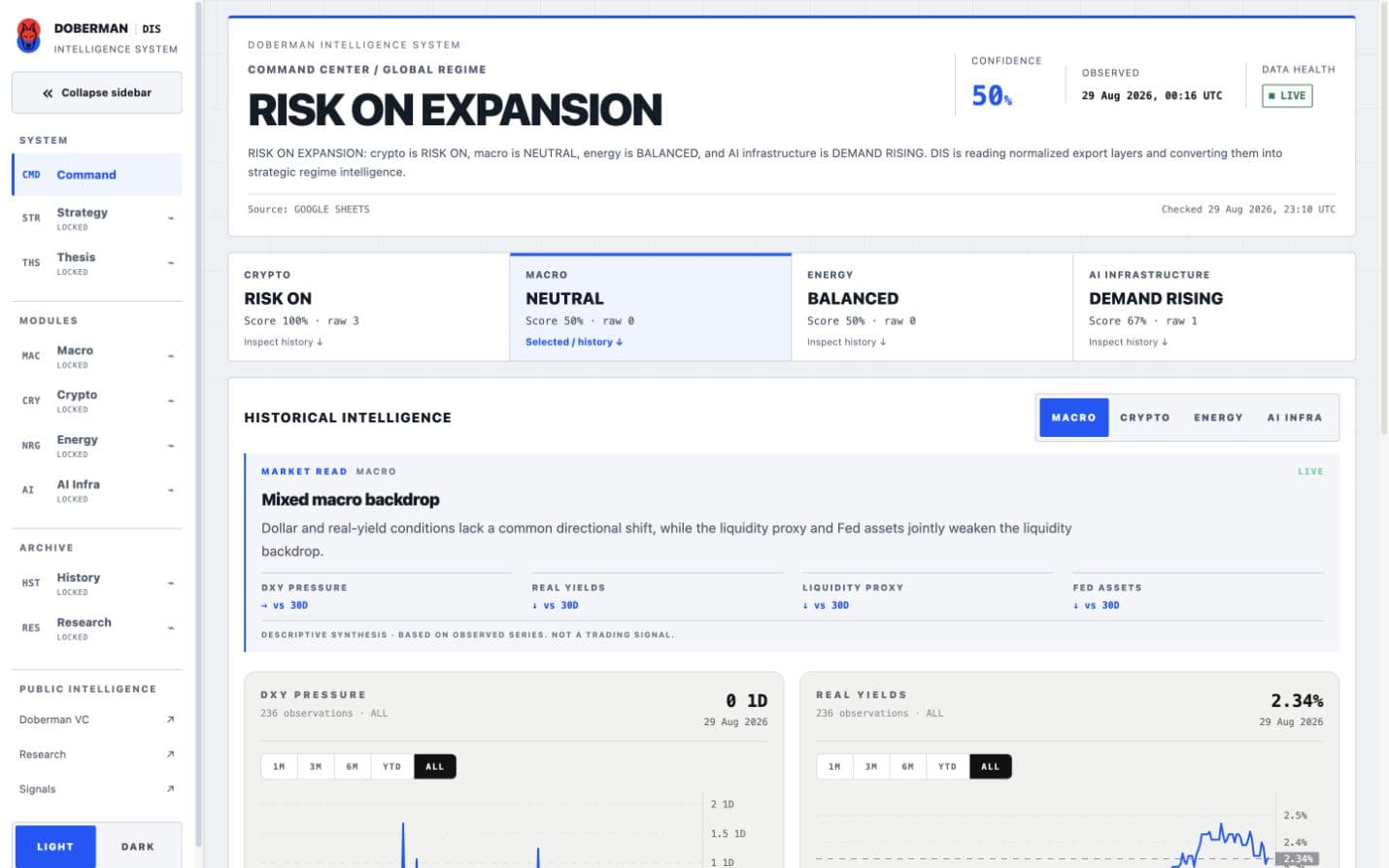
The workspace
From current regime to historical intelligence.
One operating environment connects current state, strategy, thesis, module intelligence, market memory and research.
Validation discipline
A signal is not finished when it is published.
The target operating model compares signals with later outcomes, records hits and misses, and reviews assumptions. The purpose is not to defend a past call—it is to improve the next one.
- 01Signal
- 02Outcome
- 03Review
- 04Adjust
Disclosure boundary
Public proof.
Private method.
- Current state and timestamp
- Primary drivers and contradictions
- Confidence and evidence quality
- What would change the view
- Source weighting and thresholds
- Transformation and scoring logic
- Model implementation details
- Internal monitoring infrastructure
Terminal status
The system is live.
The public terminal exposes current system state and selected historical intelligence. Deeper Strategy, Thesis, module intelligence, Market Memory and Research are available through the DIS access layer.
Doberman Intelligence System
The system is live.
Explore current market state, historical intelligence and cross-market evidence inside the terminal.